Author Archives: rabbeinu

How We’re Wired?

One day a scorpion asks a Frog for a ride across the river. The Frog responds, “Are you kidding? Of course not! I know you, Scorpion, and you would sting me and I’d die. No way will I carry you on my back!” The Scorpion challenges the Frog, “Why would I do that? If I sting you and you die, we both drown. You have nothing to fear by carrying me across the river.” The Frog decides that what the Scorpion said makes sense, so he agrees to the request.

Midway across the river, the Scorpion stings the Frog. As the Frog gasps his last breath before drowning, he implores the Scorpion, “Why? Why did you sting me, knowing we will both drown?” The Scorpion replies, “It’s my nature.”

This well-known story is a proof text for a commonly held belief. We are who we are, wired from birth with our flaws and talents, likes and dislikes, and attitudes and character traits that are immutable. This deterministic perspective essentially seals us off from any true chance to alter the trajectory of our lives.

The notion that the die is cast from birth is so depressing. Jerry Maguire says to his recently wedded wife who sees their marriage tanking because he can’t open up his soul to her, “What if I’m not built that way”? In other words, what if his fear of intimacy is in his DNA? What if whatever he’s doing is all he can do?

Are our lives predetermined by our biochemistry?  Are we doomed just to keep kicking the same old dented can down the road? Is there nothing we can do about our rough spots? Is it all about repetition compulsion, just repeating the same mistakes over and over again?

While this debate continues in philosophy, psychology, and neuroscience circles, in our tradition there is no argument or ambiguity. Judaism teaches that we are a work in progress. We are not held captive by inborn twisted character flaws. “What if I’m not built that way,” doesn’t work in the Jewish tradition.

Judaism doesn’t work if we don’t have the freedom to choose right from wrong. God does not predetermine ANYTHING about what we do in the world. The Holy One provides an ethical foundation, and then it’s up to every individual to decide how to interface with that foundation.

It is, of course, no accident that I chose this topic for today’s Before Shabbat. With High Holy Days coming up, with all of our liturgical references to repentance and forgiveness, it’s worth reiterating that we truly do believe in this process. We can become better human beings. We don’t have to keep shlepping the angst and pain. There are no rewards for stubbornly sticking to one’s story, even when we know we’re maybe a little wrong. For the Jewish people, biochemistry aside, if you decide you want to change, then you can change.

This process of self-improvement, of repenting one’s sins and forgiving people who have hurt us, is not easy. In fact, it’s extremely difficult. We adopt so many bad habits. We pursue foolish goals that divert us from the task of living life to its fullest. We get caught up in the cycles of avarice and greed. We don’t take a stand.

And yet, all of this aside, we do have the ability to change, to reach for something more. We can be more than what we are. It “just” takes time and effort and dedication. This is a lifetime struggle, not just a quick reflection before the new year.

You can think and think about change, but ultimately you’ll have to start. Yes, change is hard. Yes, it involves taking responsibility for your life. Yes, it requires you to give up the familiar, which no matter how unpleasant can still feel comforting. And yes, change will put you face-to-face with loss. But what’s beautiful about this loss is that while you might have to give up the hope for a better past or a less painful present, the future is squarely in your court.

There is no finish line on this. There is no completion, no perfection. There is only free will and our courage and resilience to look in the mirror and acknowledge that we have lots to do to make the world – and ourselves – better, more viable.

The theme of Teshuvah – repentance – is not some hypothetical suggestion. It’s a real challenge to each of us. So come to temple. Come be inspired to stand tall. Come rededicate yourself to living a life of openheartedness and meaning. Come remember how to be a mensch.

Don’t forget that Saturday night is Selichot. At 8 pm there will be lots of contemplative space for prayer and meditation. Join us; it will absolutely put you in the right frame of mind and soul.


Shabbat Shalom,


rebhayim

Pray

 Like many of you, I have an obsessive need to know what is going on. In this postmodern, media-blitzed cable news world, it feels almost possible to attain this admittedly unattainable goal. When news coverage of big – and not so big – stories is available 24/7/365, I am like the proverbial moth drawn to the flame. Or in this case, drawn to the glow of the tv/computer monitor.
I’ve spent inordinate time and emotional energy in front of screens this past week or so. The sheer devastation of Harvey and Irma, and, this just in, an earthquake in Mexico and another hurricane, Jose, churning in the Gulf of Mexico, has kept me clicking back and forth like crazy.
It beggars the mind even to attempt to grasp the real and the potential losses in life, in dollars, in livelihoods, in property, etc. My friend Carol, from Houston, texted back a description of her situation. “It’s really horrible. I lost my car and all the contents of my apt. My kids and grandson all live in Plano and so my son Howie took over and decided to come pick me up! I’m leaving Houston for now to stay with them up in Plano until I figure out my next move!! I’m totally out of sorts and don’t know what’s coming next just know I’m putting my life in my kids’ hands for a change – what do I need – prayers!!!”
So I’ve been praying… Not for miracles or flood relief or just and equitable insurance. I’m asking the Holy One to give Carol strength, Carol and all of the many victims in Houston and the Caribean and the residents of Florida… The list spirals out of control like the wicked winds of the hurricanes.
What does prayer do in this case? If I’m supposed to know the answer to that, then I’m in trouble. All I can explain is what I hope it does for Carol et al. By praying to God, my words, along with the collective prayers of the world, add a kind of energy and intentionality to the compassion the victims experience. Our combined prayers are a reminder to the victims that they are not alone or forgotten. In this way, the compassion is a sacred compassion.
Or not. I can’t prove any of this to you. I just know that my faith leads me to believe that my love and hope for others is channeled through God who then channels it back through us. It’s a continuous loop.
I imagine folks like Bill Mahrer, famous for detesting religion, would roll their eyes at the above sentiment. “So great! You’re praying, and people are homeless and overwhelmed. How helpful.” Let me hasten to reassure you that prayer alone is essentially meaningless without deeds. It matters less that I’m praying for victims of hurricanes and more that I’m sending them tzedakah. I get that.
Maybe the praying is more for me and my soul. Maybe it’s a way to connect to the sacred in the midst of these terrible natural disasters. It gives me a chance not to feel so overwhelmed by the darkness. By asking God to give Carol strength and resilience, I am in fact asking the same for me, because day by day, minute by minute, who knows what will happen next? Flood, storm, hurricane, fire, water… I know I can’t figure this out alone. And I know God’s presence comforts me.
This is one of those “Praise God and pass the ammunition” moments. We are all needed to help alleviate suffering and injustice. We do it with cash, with donations of clothing and food, and with heartfelt prayer.

What Happens Next

I had planned that my first Before Shabbat of the season would be a breezy, schmoozy, “What I did this summer” report. And it was a wonderful summer, hanging out with friends and family, reading some great books, chillin’ with my grandson, grilling fresh fish and veggies for every dinner, and spending quiet time with my wife. But something happened. Charlottesville happened, and I need to connect with you, my temple family.

There have always been people around who hate Jews. There are so-called explanations for their hatred: Jews are the quintessential outsiders who don’t fit in. Jews are cheap. Jews own Hollywood and Wall Street. Jews are rich. And that old stand by, the Jews killed Jesus.

These tired old lies have floated around such a long time, some for millennia. We’ve seen how these antisemitic slurs have been effectively used against us over the centuries. We’ve experienced the despair of being singled out, isolated, persecuted, rounded up, and murdered.

As American Jews, we’ve seen instances of true antisemitism. Quotas kept Jews out of universities and grad schools and hospitals. We’ve been discriminated against by country clubs and real estate developers. We have felt the sting of prejudice in a million little cuts.

Today, American Jews are prosperous and exceptionally successful. We are, in a word, everywhere. Sure there are places where Jews may not be comfortable or where management keeps a lid on too many Jewish hires. But our presence in every aspect of American political, cultural, and economic life speaks to our extraordinary perseverance. It also assures us a kind of safety that we’ve never known in our long history.

It is precisely our success and acceptance in this great country that makes the events at Charlottesville so troublesome and heartbreaking. I’ve seen neo-Nazis over the years, their pathetic strutting and ‘seig-heiling’ so reminiscent of dull, unwashed school yard bullies. Then there’s the KKK in their bizarre superhero capes and hoods, screaming about white superiority while proving how not superior they are just by standing there… No, I don’t much worry about these sad, powerless people and their limited understanding of the world.

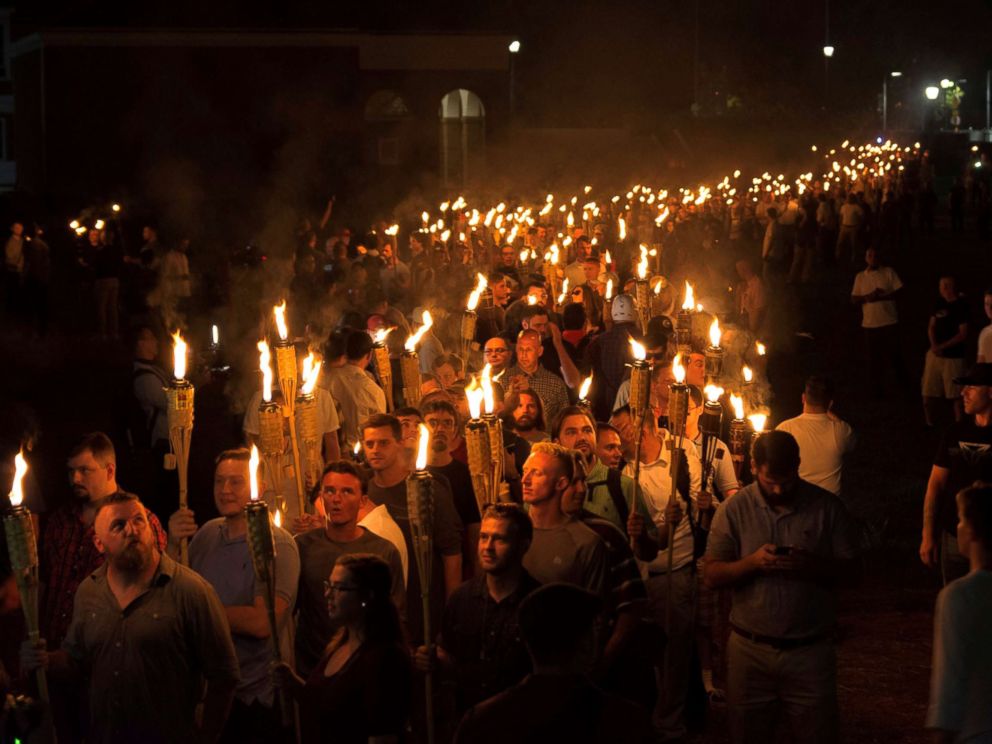
What did give me pause was the candlelight vigil and the alt-right white boys marching through the University of Virginia campus in their polo shirts and khakis. This is a new look of hatred. These are the people who once believed that their racist ideology was contemptible in American society, that they had to hate quietly. These are the guys who tell Jew jokes at work, but only when the coast is clear. These are the haters who never, in their wildest dreams, believed that they could walk around in public, chanting antisemitic epithets out loud. This is the personification of the despicable rhetoric of hate loosed in the presidential campaign of 2016.

What do we do? We stand together. We are resolute. We refuse to allow Jews to be victimized by the alt-right. We remain vigilant not only for own safety but for the safety of minorities who the alt-right also objectifies and threatens.

We demand that those charged with our public safety, locally and regionally and nationally, be adequately prepared for the antics of the white supremacists. When they move from the exercise of free speech to hate speech, when they resort to terrorist attacks to kill innocent people, law enforcement must unambiguously crack down on them.

We call on our elected officials to speak out, to call Charlottesville exactly what it was: a white supremacist demonstration that gave way to violence. We ask our elected officials to safeguard the rights of innocent men, women, and children, to stand with them, to state that without exception, such behavior is anti-American to its core. We must hold our elected officials accountable for their words and deeds in these times.

We cannot look away and pretend that this is nothing but an aberration. It is not an aberration – it is a new form of fascism crawling out from under a heavy rock.We must identify it and chase it to the garbage heap of history. How? By aggressively prosecuting them. By pointing out just how out of synch they are with postmodern Western culture.  By proving that we can live in a multi-cultural nation. By not being afraid.

Yesterday I went to a gathering at City Hall in Newton. Mayor Setti Warren was there along with Congressman Joe Kennedy. They decried the violence in the streets of Charlottesville. They challenged all of us to see ourselves as responsible for gathering together for reassurance and courage. They reminded all of us that we have to stand strong in the face of insidious hatred.

This Friday night, Susan and I will be on the bimah, rallying our congregation. We know that there’s not a lot we can do to change things quickly, if at all. We aren’t naïve. But we understand this much: we need each other. We need to know that we care for and about each other. We stand together in strength. We pray for God’s sheltering presence, and that in God’s presence we gain a true resilience born of experience and action. Let’s gather for peace and empowerment. Shabbat service is at 615pm.


PS The events in Spain and Finland remind us just how vulnerable the many are to the few who hate. Our thoughts are with all those who have lost friends or loved ones in this latest paroxysm of outrageous violence. As members of the human race, we are all diminished when the innocent are targetted.

It’s That Time

 This is the final Before Shabbat of the TBA cycle. It goes on hiatus until September. I love the weekly opportunity to reflect on things large and small and then to share those reflections with you. I always try to find ideas that touch on matters of spirituality or ethics or Israel or Reform Judaism or movies or music or… well, anything that is interesting and topical.
There are weeks when there are so many things happening that it is hard to drill down on just one topic. On the other hand, there are times when I am reviewing the week and the news and the temple and my life, waiting like a fisherman for something to suddenly strike and take the bait.
I appreciate it so much when you tell me that you’ve read a particular blog and found it worthwhile reading. I know just how many emails you probably receive and how often you bother clicking on anything in your inbox. Thank you for taking the time to read it. Some of you have told me that you forward Before Shabbat to other people. That means a lot to me as well, knowing that Before Shabbat spreads beyond the immediate Beth Avodah family circle.
 I also appreciate it when you read something with which you take issue and then you share your question/concern. I want to engage and connect with Before Shabbat. I want to know when you think I’m speaking your language and when you’re sure that we’re not on the same page.
As Before Shabbat goes into hibernation and as I slowly roll towards my annual month on the Cape, I am in a reflective state of mind. How could that not be so? After all, I am entering my 20th year at Beth Avodah!
This is such a major professional and personal milestone for me. To be in one place for so long is itself something to celebrate. The new normal for Millennials is to jump jobs four times in the first decade out of college! Twenty years is a generation; I’ve had the enormous thrill of watching a generation’s worth of children grow to adulthood. I have said hello to lots of babies. I’ve said goodbye to folks, too, including my mom, in these past 20 years. So many weddings and B’nai Mitzvah and graduations and big moments. So many moments of study and dialogue. Traveling to New York and Israel in buses and subways and taxis and camels and even a hot air balloon! So much laughter, and tears, and common cause. And so many quieter moments of conversation: in my office, on the street, over a good meal, over the phone, email, texts, and more.
Sometimes my friends kid around with me and call me the happiest rabbi in America. I’m not sure if that’s true. What I do know is that I am blessed to be where I am doing what I do. It is a calling. The notion that I am doing exactly what God wants me to do is a sobering and a daunting fact. It means the expectations are enormous.  I take this truth to be an ironclad obligation to my congregation and to my people. Being a rabbi is not what I do; it’s who I am. For better and for worse, I have no rabbi face or rabbi voice. This is it; I’m all in – it’s just me.
I have a pile of books for the summer (including Now: the Physics of Time by Richard Muller, At the Existentialist Café, by Sarah Blakewell, and Moonglow by Michael Chabon, among others), a new beach chair (Renetto Beach Bum 2.0), and some great places to plant myself. I have some recipes for summer gustatory pleasure and hopes that the wifi connection at the summer house we rent is good enough to watch the new season of Game of Thrones.
5778 is going to be filled, God willing, with lots of celebrations and Simchas for us all. I look forward to toasting l’hayyim for 20 years of the deep, abiding love and appreciation I have for TBA. I also look forward to all of the good things yet to be, the events that await our attention and the ones that will spring upon us. We’re in this together, and that is comforting and exciting.
What are you reading this summer? What kind of beach chair are you sitting in? Where will you be?
Whatever you do, take some time to breathe and some time to give thanks. Be healthy and safe.
Shabbat Shalom,
rebhayim

A Six Day War Remembrance

As I was doing last minute prep for my Bar Mitzvah – going over the Torah and haftarah, learning how to put on tefillin, reviewing English readings – Israel was under siege. We were all glued to every news report that mentioned Israel. And as you can imagine, it was mentioned with increasing frequency and urgency in the spring of 1967.

In mid-May of that year, President Nasser of Egypt started moving thousands of troops and armor divisions into the Sinai in direct violation of an agreement they made with the UN. He then ordered the UN to leave the Sinai Peninsula. Though Nasser had no authority to do this, The UN responded and withdrew their peacekeeping forces. And Jews everywhere began holding our breath, brooding over when Nasser would take his incendiary rhetoric about destroying Israel to its logical conclusion.

I always loved reading the news and listening to Walter Cronkite, so I was current on the situation. It was so long ago, yet I clearly remember that on June 1st, as the situation continued to escalate, it dawned on me that there might be a war in Israel before my Bar Mitzvah. What would I do? Would the Bar Mitzvah be canceled?  Would something horrible, unthinkable occur?

I asked my tutor if there was some contingency plan for a canceled Bar Mitzvah. What if, I asked him slowly, what if Israel is attacked? What if Israel is captured? What would we do? Cantor Bernstein looked at me. tears welled up in his gentle eyes, and, in mine, too.  He was a Holocaust survivor, and he had family in Jerusalem. Cantor Bernstein told me that no matter what happened, my Bar Mitzvah would never be postponed. “Life always rolls forward. Shabbat comes, in good times and hard times. In peace there is Shabbat. In war, too. Even in Auschwitz, there was Shabbat.”

“Ok,” I said, “But what if something terrible happens? What happens if Egypt attacks and Syria and Jordan attack, too?” “Number one, you will have your Bar Mitzvah. Number two, Israel will survive whatever is going to happen next, because it has to survive. Because after what Hitler did, Jews can’t be victims again. We won’t be victims again.”

He seemed so sure of himself! I took his certainty and made it my own. When Israel launched the surprise air attack against Egypt on June 5th, I somehow knew that, in the end, everything would work out. Because Cantor Bernstein said so. Because we could never allow for defeat.

In the few weeks that followed, the Jewish world reveled in the extraordinary victory of what came to be called the Six-Day War. My Bar Mitzvah ended up being a Shabbat of celebration. I talked about how cool it was for Jerusalem to be back in Jewish hands. I remember saying something about how one day I would pray at the Wailing Wall.  But I remember most clearly when the Cantor came up to me after the service and gave a bear hug. As he did, he whispered to me, “You see? We will never be victims again.”

I will always remember that hug. And I will always be grateful for Cantor Bernstein’s faith and strength. He enabled a frightened boy about to have a Bar Mitzvah, feel confident, not just about a ceremony, but most significantly about the future of Israel and the Jewish people.

That confident feeling I acquired 50 years ago still lingers, as does my great love of Israel. The hard truth, however, is that since the Six Day war, peace remains more elusive than ever. And in the end, Israel’s greatest legacy cannot be about a fantastically executed war. The only legacy that will have lasting meaning is to make peace.


Shabbat: the Gift that Keeps Giving

On some weeks, Shabbat arrives like a surprise visit from an old friend. We say, “Hey! I wasn’t expecting to see you here… come give me a hug!” Other weeks it feels like the timing is off. “You again? So soon? Weren’t you just here?” Then there are the weeks when Shabbat is just one more thing to plan for and worry about. “Ok, who’s coming over when with whom? How many meals do I need to prep?”
Occasionally, Shabbat can’t come fast enough. We look out the window. We check the calendar. We go to various websites. We plaintively ask, “When is Shabbat going to get here?” We need Shabbat. We need the respite from the crush of labor and the incessant yammering of people who say they know what’s good for us. We need to strive for some level of spiritual wholeness, a developed sense that we are not the center of the Universe, the truth that we are dependent on people – friends and strangers alike – to take care of us, to share in the stewardship of our world, our lives.
We push so hard all the time. We want to get ahead; that’s one of the most important rules of the game, is it not? Time becomes a boxing cage. Time turns into an ever shrinking space that will crush us unless we can slip under the closing vault door before its too late. Shabbat comes to the rescue.
Rabbi Abraham Joshua Heschel once wrote that… “the Sabbath is entirely independent of the month and unrelated to the moon.  Its date is not determined by any event in nature, such as the new moon, but by the act of creation. Thus, the essence of the Sabbath is completely detached from the world of space. The meaning of the Sabbath is to celebrate time rather than space. Six days a week we live under the tyranny of things of space; on the Sabbath, we try to become attuned to holiness in time. It is a day to which we are called upon to share in what is eternal in time, to turn from the results of creation to the mystery of creation; from the world of creation to the creation of the world.”
But: here’s the thing. If you don’t embrace Shabbat, there is no other true respite like it. Embracing Shabbat doesn’t mean you must become Orthodox and obey Jewish law about driving and using electricity, and so forth. In fact, it’s all too easy for observant Jews to get stuck in the minutiae of ritual without looking up to see the arrival of the Shabbat bride. With all the worry about lights left on and off and screw tops on bottles pre-opened before sunset and the temperature of the cooking surface left on overnight, there’s not a lot of room for actually attuning to holiness in time.
For postmodern Jews who don’t carve out even a sliver of Shabbat space in their lives, a great treasure is discarded. To sanctify time on Shabbat is to get real and get centered. Even if all you do is light candles or have a family meal or even come to services! I always say that if you come once every six weeks, at the end of the year, I guarantee that your life will change for the better. Trust me, it’s true.
So get out your smartphone and schedule a Friday night at the temple, one every 6 or 7 or 8 weeks. Commit! Dare to find a small island of the sacred. You don’t have to sing or dance, though you can if you want to. You can come in and sit in the back the whole time without getting up. Just come and float in the warmth of Shabbat, of music and spirit and stories and community and laughter and tears. You’ve got nothing to lose and everything to gain.
Shabbat Shalom
rebhayim

An Early Start

When the temperature spiked this week from 45 to 90 degrees, it threw me off a bit. As if in a dream, I started packing for the Cape, our annual summer destination. This, in turn, activated a lot of signals to my hippocampus, awakening memories of what comes along with the Cape.

At the beginning of every summer for close to 40 years, I contemplate the upcoming new year.  I ponder so many different things. I think about my life as a pond with concentric ripples fanning out. The first circle is my immediate reality: my body, my choices. Next are my wife and kids, my relatives and oldest friends. Then comes my temple family, the people I work with professionally, and the congregation I serve. And then there’s the more diffuse local, regional, national, and international issues that involve and intrude on my pond, like a thunderstorm or a cool breeze or a blizzard, depending on who’s doing what where.

This is the pond into which I jump every day. But in the heat of these last few days, I’ve started to especially examine and reexamine the waters, as if Rosh Hashanah were around the corner. I’m not complaining – after all, a little extra time spent in reflection mode can’t be bad.

But it does make me wonder: what’s this world coming to? And what am I coming to? Surely with age comes an acute sense of limits and finitude. But just as certainly, with age comes wisdom. In fact, the book of Psalms, 90:12, suggests that acknowledging mortality leads to wisdom. “Teach us to number our days, that we may attain a heart of wisdom.”

Yes, there’s a beginning, a middle, and an end to everything – except God – and maybe the multiverse. As spring edges to summer, as summer pushes towards Fall, there is this sense that a personal account checking is in order. It’s time to explore our blessings and challenges of the past year and how we have responded to them.  What kind of connections have we made? What connections have we broken?  It’s a time to reflect on the fact that we live in relationship to each other and all the earth. And it’s a time for honest reflection, forgiveness, celebration and healing.

I know, I know. I’m a little bit early. I’ve put away the summer clothes box and the Crocs. But I’m stuck with this looming sense of urgency ignited by the weather. I think I’m going to stick with it, see where it takes me.

Rabbi Eliezer taught “Repent one day before your death.” His students said, “Rabbi, how is that possible if one doesn’t know the day of one’s death?” To which Rabbi Eliezer responded, “Aha! Making amends and being in spiritual balance is not something to put on layaway! It must always be in your mind and heart.”

The rabbi has a point. What matters most, in the end, is not how many toys we have collected. What truly counts is to be wholeheartedly clear that, at the end of the day, we have done our best to do the right thing. How to be clear? That’s the work. And now that the heat has activated the High Holy Day prep syndrome, I’m on it. As Rabbi Eliezer indicates, it’s always the right time.

Shabbat Shalom

rebhayim

A Perfect World Somewhere

The book of Leviticus describes the sacrificial cult as ordained by God and supervised and executed by the priests and the Levites. The cultic slaying and skinning of animals, the draining of their blood, consuming the offering, burning the rest, offering up various birds and grains, and so forth, are all exhaustively discussed. There are lots of details regarding methodology.
I’ve always wondered: what must it have been like in the temple courtyard, animals braying, altars burning, people leading oxen and goats, carrying cages of birds and baskets of fruit and grain? The answer is that… there is no answer. There are no descriptions of the sacrificial cult. When the Second Temple was destroyed in 70CE, not a thing was left behind. It was obliterated to show the Jews as well as the rest of the world, that Roman gods were stronger than the Jewish God.
As I read Leviticus these days, I’ve come to wonder: was there ever a sacrificial cult? Or was the whole thing a projection of a perfect world, where sin can be removed, where a contaminated body and soul can be cleansed, where atonement is possible? In a world of uncertainty, did our ancestors find peace in a series of stories and images that “guaranteed” God would hear them and accept their offerings?
World of uncertainty surely defines where we live today. Anything that might assuage anxiety about the unknown would be so useful. I listen to the news as I always do. This week, despite all of my reading,  I have no idea what’s going on. Who is in charge? Who is guilty? Who is innocent? Should I be worried about 1) the Russians 2) the North Koreans 3) the Chinese 4) ISIS 5) Hamas 6) the FBI 7) the President 8) the Left 9) the Right 10) etc. Someone, please! Assuage me!
In the perfect alternative Universe of Leviticus, you offer up a sacrifice without blemish. The priest does the sacrifice on your behalf. God receives it. Done. It’s all in God’s hands. Everything is clear. There is no uncertainty.
Well, I’ve got some news. God does not control us or our fate in this world. God cannot change the way of any human being who refuses to ponder their choices. I believe that God loves us, implants within us the capacity for love and faith and compassion and nurturance. But God does not install spiritual fog lights in our souls. God can help us define the way to be, but cannot clear the way for us.
The perfect world has a sacrificial system. It has clear, absolute answers. We have prayer. We ask God to give us strength and resilience. That God can do. But the transaction happens, not on an altar, but in our hearts.
This is a crazy Universe, far from perfection. God roots for us, for all who seek peace and reconciliation. It is not an option to passively sit it out. Every minute counts. There is no sideline.
I dream of a perfect world. It isn’t about animal sacrifice or priests making offerings on my behalf. In my perfect world, it’s about human understanding, it’s certainty that we are, all of us, in accord, accepting our unique capabilities even as we unite in common cause over what we share. It may be that my perfect world is as far away as was the world of Leviticus. But I will never cease to talk about it and dream about it and share it with you and with God: in prose and music and prayer.

What Counts

We are at the time of the counting the Omer, in case it slipped your mind. I know. You’re scratching your head and wondering what this is all about. Here’s the text citation: “You shall count from the eve of the second day of Pesach when an omer [approximately 9 cups] of grain is to be brought as an offering [to the cohanim in the Jerusalem Temple], seven complete weeks. The day after the seventh week of your counting will make fifty days, and you shall present a new meal offering to God (Leviticus 23:15-16) [It’s also the beginning of the holiday of Shavuot, which commemorates when we received the Torah].”
You may ask, “Why does God ask the Israelites for a measure of grain for 50 consecutive days?” The answer, a wise and enduring answer as we ponder the Torah, is “We just don’t know.” Perhaps it was a sign that the spring grain was that significant. God wanted to declare its centrality by featuring it so prevalently.
Originally there wasn’t even a link between the Omer offering with Passover or Shavuot other than proximity on the calendar. But the rabbis are always looking for connections, always trying to link events to form one meta storyline. Counting the Omer has become a primary nexus point between Passover and Shavuot.
There is another question I have, one that pushes Jewish practice – mine individually, and ours, collectively – is, “Why do we continue to acknowledge this ritual by counting up, every night, at the end of services?” This question leads us to a deeply existential confrontation. If after the year 70CE, there is no more temple where sacrifices were once offered up, why is it so important to acknowledge the Omer tradition? In fact, why bother?
I know asking, “Why bother?” is a slippery slope when it comes to examining ritual practices. But this one is so arcane that it cannot be ignored.
The Reform movement was born when people began questioning ritual observance, wondering why certain practices were required. They began asking why men and women couldn’t sit together. They asked why to keep kosher. They wanted to know why they couldn’t have beautiful instrumental music in their synagogues. They wanted to know why being Jewish felt restrictive and constrictive.
To be a Jew is to inherit a long and complicated tradition, filled with astonishing twists and turns, monumental change, push back and blowback. The archetypal traditional Jew, Tevye, sings about tradition and stalwartly stands strong with it. But even Tevye, buffeted by change and loss, wonders what the true price is to hold onto a tradition that no longer fits, no longer makes sense.
Some may consider it sad, or even heretical, to relegate long practiced ritual to the dust heap of history. But if it no longer serves its purpose, if it becomes a mindless, rote procedure, then why bother? There is so much to celebrate in our tradition. There are so many ways that being Jewish challenges us to step up and be truly present. There are so many ways to access the best of our Judaism. Wouldn’t this be the right time to find new paths to God and to community?  Instead of worrying about remembering to count the Omer, doesn’t it make more sense to remember to bring to the temple some non-perishable offering to the Jewish food bank, Family Table?
For our tradition to be worth something, it has to mean something.

What a Beautiful World It Will Be 

I grew up with the bedrock Western philosophical assertion that as time goes on, life will get better. People of all colors and creeds will recognize that what joins us together is so much more significant than our differences. As our technological skills increase geometrically, so too will our ability to cope with issues like poverty, hunger, and disease. The cup will not be half-full. The cup of Western civilization will “runneth over.”

This ideology is best expressed in a Donald Fagen song called “IGY” which stands for International Geophysical Year. The IGY was an international scientific project that lasted from July 1, 1957, to December 31, 1958. It marked the end of a long period during the Cold War when scientific interchange between East and West had been seriously interrupted. Sixty-seven countries participated in IGY projects. The promise of a new course for the world was palpable. When Kennedy was elected, the New Frontier promised a world soon free of fear and oppression.

Standing tough under stars and stripes
We can tell
This dream’s in sight
You’ve got to admit it
At this point in time that it’s clear
The future looks bright
On that train all graphite and glitter
Undersea by rail
Ninety minutes from New York to Paris
Well by seventy-six we’ll be A.O.K.

What a beautiful world this will be
What a glorious time to be free…

A just machine to make big decisions
Programmed by fellows with compassion and vision
We’ll be clean when their work is done
We’ll be eternally free yes and eternally young

What a beautiful world this will be
What a glorious time to be free

The lyrics simultaneously recall the spirit of the moment, the true belief that we were really on to something. After the Holocaust and Hiroshima, we were ready to forge ahead into the New Frontier. Of course, the lyrics also evidence the profound naivete of that time and are actually sad.

We are farther than ever from a beautiful world. There is so much fear. People are more divided than ever into political and socio-economic wagon circles. The cup has gone from overflowing to cracked and slowly leaking out.

It is at such moments, reflecting on the hope that was and the present sense of doom and disappointment, that we Jews need to reflect on our history and philosophy. We survived the destruction of the Second Temple, actually emerging from that traumatic period with renewed purpose and resilience. We did not fold, though many other civilizations teetered and fell under far less dire circumstances. The fact that after 6 million perished during the Holocaust we did not shut down and quietly fade into history is the example par excellence of Jewish grit.

We have faith in our story of rising and falling and rising again. We have faith in the value of life in all of its diversity. We don’t need the world to be Jewish to justify our existence. Because we are all created in God’s image, we know that that we have an ongoing obligation to make this world better than it is right now. Some Jews believe that the completion of history will come with the arrival of a Messiah, a human designated by God, to bring about a beautiful, perfected world. That belief is often accompanied by the necessity of war and struggle and bloodshed as preliminary to the great peace.

Most Jews no longer believe in a personal Messiah. Instead, we contend that there may be a time called the Messianic era and that we, not God, are the architects of that time. So we work. We build. We pray. And then we build some more. And even though logic might suggest that the world as we know it is circling the drain, we persist. As Rabbi Tarfon teaches in Perkei Avot, “You are not required to finish your work, yet neither are you permitted to desist from it.”

We are not looking for perfection. It’s not about the dream being in sight. It’s about making it better. That’s our job: through our work and the sweat of our brows and the hopes we cultivate, to make it better.


Shabbat Shalom

rebhayim